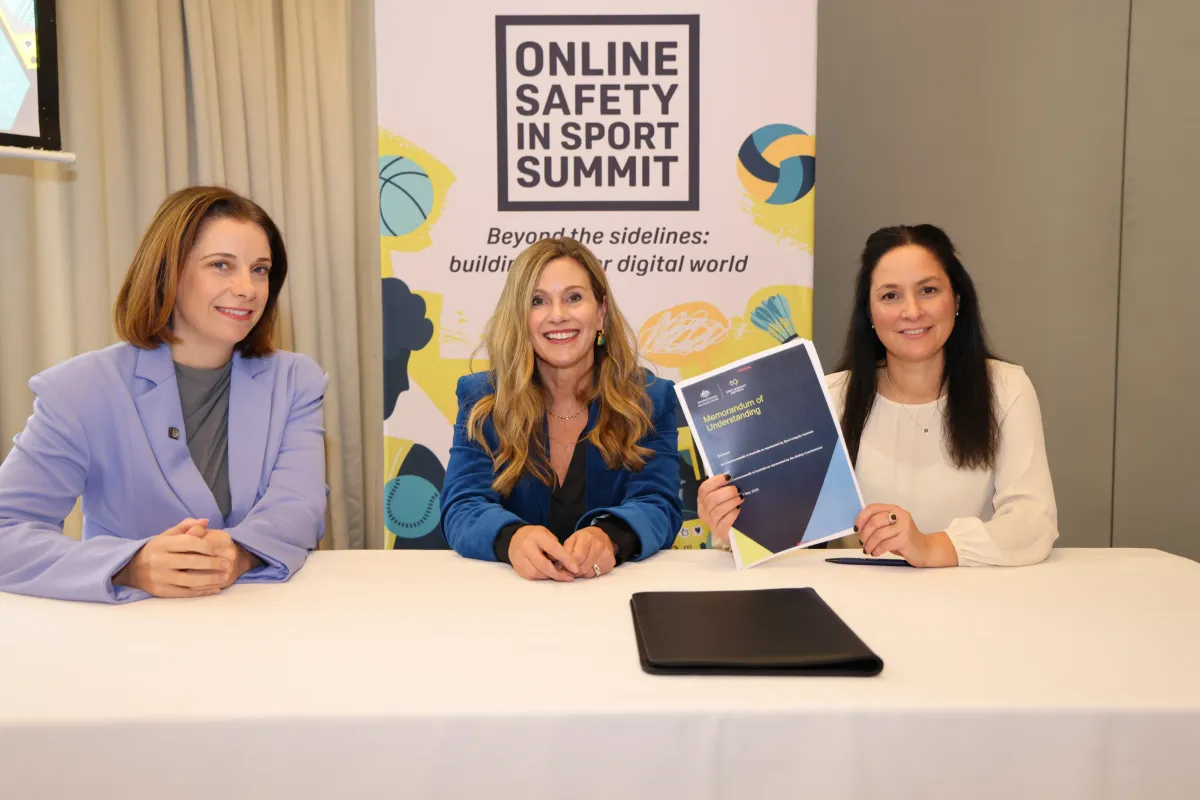
Jointly hosted by Sport Integrity Australia (SIA) and the eSafety Commissioner (eSafety), the Summit brought together senior leaders from sport, government, law enforcement, policy and the technology sector to strengthen collaboration and drive action on online abuse in sport.
Attendees heard from speakers across the sector, including Dr Emma Kavanagh, a leading international researcher on online abuse from the University of Loughborough, as well as Australian athletes and officials with lived experience of online harms, and technology industry partners.
The Hon Anika Wells MP, Minister for Communications and Minister for Sport, also attended and acknowledged the work of SIA and eSafety in supporting sporting organisations with practical online safety resources and training.
SIA’s Chief Executive Officer, Dr Sarah Benson PSM said protecting participants from online harm is now central to safeguarding the integrity of Australian sport.
“Sport should be a place where people feel safe, supported and respected on and off the field,” Dr Benson said.
By bringing together sporting organisations, regulators, policy and technology platforms, this inaugural Summit aims to improve our alignment and ensure we all have the right tools, knowledge and partnerships to respond to online harm.
– Dr Sarah Benson PSM, CEO of Sport Integrity Australia
The Summit reinforced a shared commitment to prevention, early intervention and person-centred responses; all while recognising that no single organisation can address online harm alone.
|
Our latest news, resources, podcasts, courses and webinars:
|
The eSafety Commissioner Julie Inman Grant PSM said while technology is an excellent tool for connecting sporting communities, it also carries safety risks.
“Harmful and abusive conduct that was once confined to the sidelines, no longer stays there. It follows people home – onto their phones, into their private messages, and into spaces where there is nowhere to escape,” Ms Inman Grant said.
As digital environments around sport continue to become faster, more visible and complex, our task is to help ensure these online spaces enhance sport and healthy competition – not harm it.
– Julie Inman Grant PSM, eSafety Commissioner
The eSafety Commissioner also released new research at the Summit titled The Digital Sideline which examines the online experiences of children involved in sport.
“Our research found that nearly one-in-five children who had participated in community sporting activities as experienced cyberbullying from someone connected to these activities and a further 6 per cent have experienced online hate from someone linked to their sport,” Ms Inman Grant said.
“Those responsible were most commonly peers – such as teammates or competitors – with harms often occurring in messages, group chats or calls.”
Together, these initiatives reinforce a coordinated approach to online safety combining leadership, education and evidence to better protect everyone involved in Australian sport.
At the Summit, SIA and eSafety reaffirmed their partnership to enhance online safety across the Australian sporting sector, including at the community level by signing a Memorandum of Understanding (MOU).
This MOU will strengthen the national approach to online safety in sport through coordinated capability, support, and enforcement efforts by:
- Building workforce capability by delivering joint training, shared resources, and secondment opportunities across both agencies and the broader sport integrity network
- Providing sector-wide support by equipping staff, integrity managers, and sporting organisations with practical guidance on online safety and sport policy
- Coordinating responses to emerging threats through a formal process to identify and address online risks, including betting-related abuse and harms targeting women and girls
- Enhancing collaboration and intelligence sharing by enabling information exchange, co-designed education initiatives, partnerships with law enforcement, and cooperation on investigations to support safer online sporting environments.
The summit brought together leaders in sport, government, law enforcement and the technology sectors to drive a coordinated response to online abuse in all levels of sport, from grassroots to high performance.